Key takeaways
- Static audience segments can't support dynamic creative optimization (DCO) at scale, but agentic AI makes continuous, behaviorally grounded segmentation possible.
- A multi-agent architecture produces richer segments faster than traditional approaches.
- Human guidance remains essential: setting behavioral guardrails upfront and correcting mid-flight keeps AI from optimizing for statistically clean but strategically useless clusters.
- The segments this workflow produces are built for activation, giving creative teams the persistent, current audience intelligence that makes DCO viable at real scale.
Dynamic creative optimization (DCO) promises personalization at scale. It allows marketers to deliver the right message to the right audience at the right moment. Most marketing teams know the capability exists. But getting there requires audience intelligence that's specific, current, and behaviorally grounded.
That's what we built for a leading real estate marketplace. Using an agentic AI workflow powered by Gemini, we designed a multi-agent architecture that runs audience segmentation autonomously, iterates on its own findings, and surfaces segments that stay current as user behavior evolves. This post walks through how we built it and where human judgment stayed essential throughout.
What it takes to make dynamic creative optimization work
Before getting into how we built this, let’s take a look at the challenges facing marketing teams wanting to pursue dynamic creative optimization.
DCO as a capability is widely available — 83% of ad executives deployed AI in creative processes in 2025, up from 60% the year before — and the tools to execute it exist across every major platform. The foundation is audience intelligence: how current it is, how behaviorally specific, and how well it holds up as a campaign runs.
Over a third of B2C brand and agency marketers say incomplete or inaccurate audience data causes dynamic elements to miss the mark. That's the specific constraint DCO has always run into. The capability to serve different creative to different audiences has existed for years.
What's been harder is keeping audience definitions current. From that same report, only one in five brands and agencies have fully implemented personalization across channels, with lack of real-time data access and difficulty unifying data cited among the primary reasons.
When you don’t have real-time data to drive personalization, you end up with static segments, with creative teams optimizing against buckets that may no longer reflect how audiences actually behave by the time the campaign is live.
For our client, the goal was making DCO work the way it's supposed to, with audience intelligence specific enough, and current enough, to give the creative layer something to optimize against. That meant building a system capable of running segmentation continuously rather than on a project basis, and grounding every cluster in behavioral signals that map to real creative strategy. The agentic AI workflow we built with Gemini is how we got there.
How we structured a multi-agent system for continuous audience segmentation
The system runs on Google's open-source agentic framework. At the center is a lead orchestrator that manages a continuous loop: waking up, reading its constraints, checking its working memory, delegating tasks, and iterating based on what it finds.
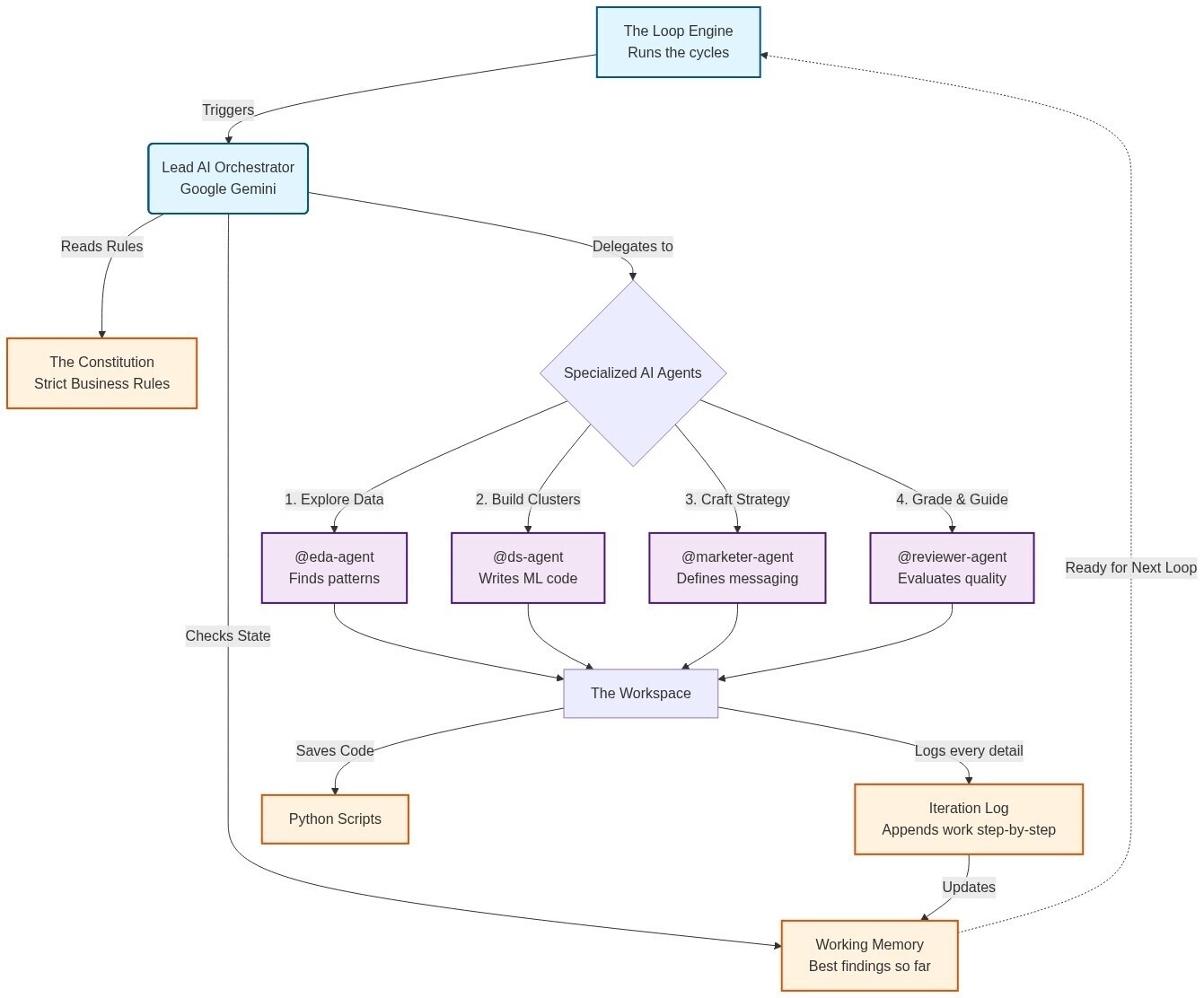
Around that orchestrator, we built four specialized sub-agents, each with a defined job.
- A data analyst agent that digs into raw behavioral data using DuckDB, scanning for patterns in how users search, filter, and navigate
- A data science agent that takes those behavioral signals and builds statistically distinct clusters using Scikit-Learn
- A marketer agent that evaluates each cluster for strategic relevance, mapping segments to messaging themes and creative hypotheses rather than just mathematical validity
- A reviewer agent that grades the work against our upfront business rules, checks for external context using web search, and produces directive feedback that feeds the next loop
Every loop saves its outputs. Generated code goes into script files. The AI's reasoning gets logged sequentially into an iteration file — an append-only record we enforced deliberately after early versions overwrote previous work to stay tidy, losing useful findings from earlier iterations. Working memory updates after each loop so the system carries forward its best findings rather than starting cold.
The workflow diagram above shows how these components connect. What it doesn't show is how much the quality of outputs depends on what goes in before the loop starts.
Why agentic AI still needs human guardrails to produce useful segments
Left to its own devices, a clustering model will find the easiest mathematical path. In practice, that usually means grouping users by engagement volume — high activity versus low activity — which is statistically valid and strategically useless for most marketing applications.
Before the system ran a single loop, we wrote what we called a Constitution: a strict set of business rules defining what the AI was and wasn't allowed to do. For this engagement, that meant directing the system to look for behavioral differences in how users search and filter — apartment size preferences, building amenities, search platform patterns — rather than how long they spent on the site. That upfront constraint was the difference between segments that map to real creative strategies and segments that describe obvious things we already knew.
Mid-flight course correction mattered just as much. After each loop, a human could review the segmentation output and push back. When the system started drifting toward desktop versus mobile as a primary segmentation axis, we redirected it. Desktop versus mobile is a useful signal for ad delivery, but it's not a meaningful proxy for what someone wants in a home. That kind of redirect requires someone who understands the business well enough to know which mathematically interesting distinctions are also strategically relevant.
This is the pattern we see consistently across agentic AI work: the system is exceptional at exploration, iteration, and scale. It will test more variables, build more models, and document more findings than any human team could match in the same timeframe. What it won't do on its own is decide which findings matter. That requires someone with enough business context to know which mathematically interesting distinctions are also strategically relevant.
Ready to explore agentic AI for your marketing stack
What this project demonstrates is that DCO's potential has always been there. The limiting factor has been the audience intelligence underneath it. Agentic segmentation closes that gap, not by replacing human judgment but by making the data layer good enough, and current enough, for human-led creative strategy to do its best work.
This is one project in an ongoing body of work. Our team is actively building agentic solutions across segmentation, campaign monitoring, and marketing mix modeling (MMM), designed from the start to plug into the marketing systems clients are already running. If you want to see what that looks like applied to your stack, we'd love to talk through it.
This post is part of Adswerve's Technical Insights series about agentic AI in marketing. Read the first post in the series here to learn more about how to connect AI to the platforms you already use.