The end of this year marks seven years since Adobe made Customer Journey Analytics (CJA) generally available. If that feels longer than you expected, remember that it’s only been the last three or four years since Customer Journey Analytics packed a feature set that rivaled (and in some cases surpassed) that of Adobe Analytics, its predecessor.
Any way you cut it, at this stage, we are deep into the next generation of Adobe’s repackaged CX Analytics offerings, so now is the perfect time to take a temperature check to see how it’s progressing.
How we measured Adobe Customer Journey Analytics (CJA) adoption
As has been the case since the beginning of web analytics, the best way to get a read on analytics tools has been good old-fashioned web scraping. While other corners of the analytics universe have seen a greater adoption of server-side solutions, the Adobe landscape has remained decidedly client-side and therefore visible to scrapers.
To complete this analysis, I scraped Fortune 500 companies for Adobe Analytics or Customer Journey Analytics implementations. My scraper evaluated them on two axes:
- SDK: The legacy AppMeasurement or modern Web SDK (the cross-product, Adobe Experience Platform (AEP)-enabled library)
- Payload shape: The structure and contents of the data being captured. Adobe Analytics requires a legacy props-and-eVars format to ingest and process data. Customer Journey Analytics can accept this format, but it can complicate future omnichannel use cases and incur a large amount of debt. Customer Journey Analytics instead favors a semantic schema that replaces the prop20 or eVar42 of yesteryear with a human-readable search.term or form.name.
Why a semantic XDM schema beats props and eVars
The payload shape axis is especially important when making the transition to Customer Journey Analytics. In many of my articles about CJA adoption, I advocate for the use of a semantic XDM schema for a number of reasons.
It’s human-readable
Semantic XDM schema is easier to read, implement, maintain, and use. If you’ve worked with the Adobe Analytics data feeds, you know how difficult it can be to traverse an unfamiliar props-and-eVars dataset, especially with outdated or non-existent documentation.
It’s machine-readable
eVar12 is just as meaningless to an AI agent as it is to a human. Data dictionaries and MCPs can help, but the reality is that many Adobe Analytics implementations have outdated docs and repurposed or shared variables. These are the exact types of data structures that lead to cautionary tales of AI hallucinating with inconsistent and incorrect answers.
It’s built for activation
Adobe Experience Platform (AEP) leverages modular data structures called field groups. This allows common data across sources to seamlessly combine into a single profile and continuous journey rather than props-and-eVars that don’t blend well with other data.
It’s debt-free
If an organization’s end goal is to sunset Adobe Analytics, they don’t want to carry the debt of a 20+ year old data format.
Web SDK adoption versus payload shape in Adobe implementations
Web SDK has been available for over five years now, and similar to Customer Journey Analytics, it lacked some key features in its earlier years. It has since closed those gaps, which are now showing up in adoption. In fact, just over half of implementations in the sample are using Web SDK in some form.
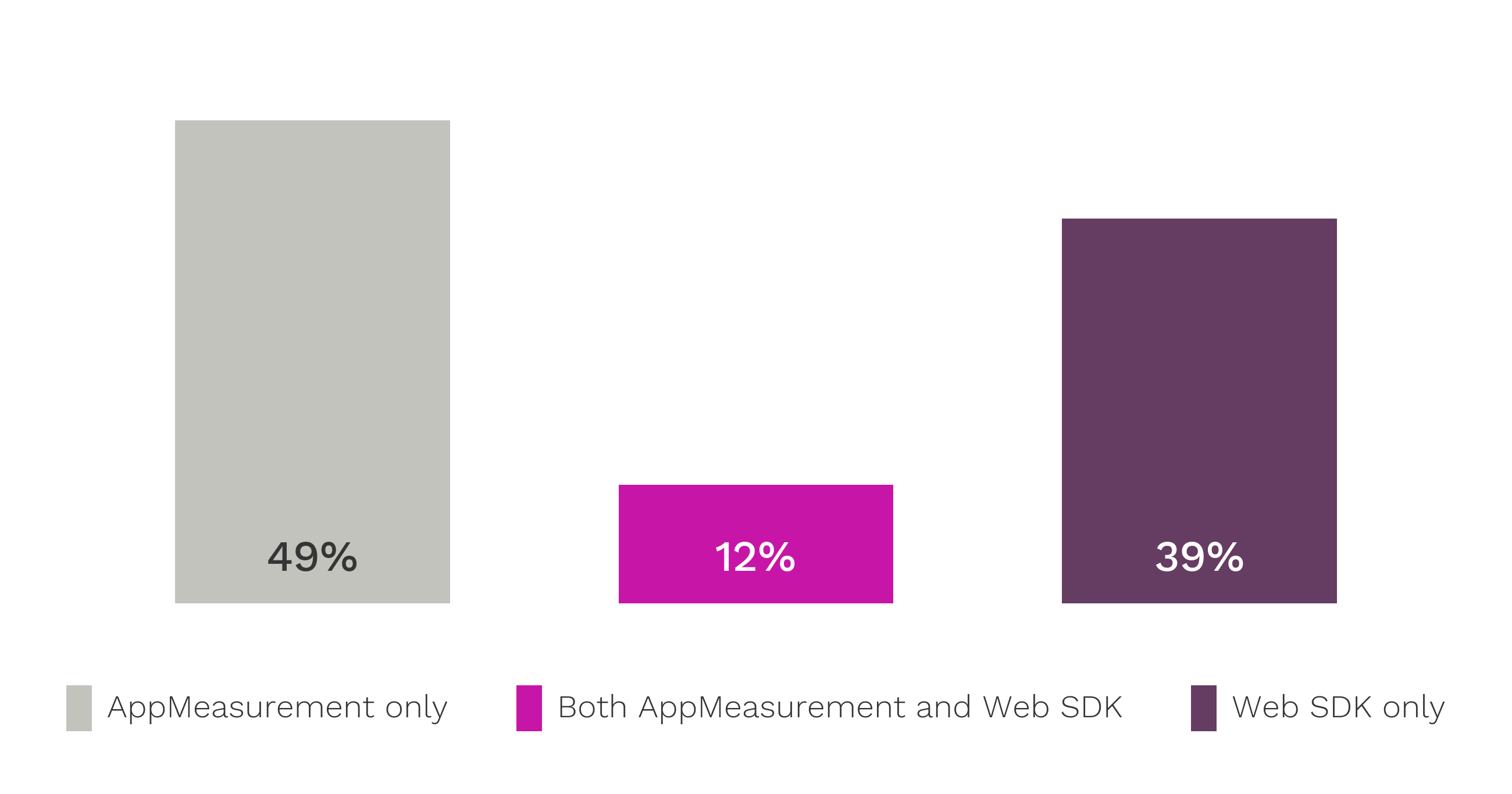
Crossing the halfway mark is real progress for Web SDK. The other half of the sample is still running AppMeasurement exclusively, which means there's a sizable group with the easier half of the modernization work still ahead of them.
The payload shape axis tells a different story. The SDKs were close to evenly split, but the legacy payload shape still dominates, which means the higher-value half of modernization is where most of the opportunity remains.
|
Props-and-eVars only 79% |
Semantic schema 21% |
|
Implementations with only the props-and-eVars shape stand at 79%. This is much higher than Web SDK adoption because most of those implementations are only supporting Adobe Analytics and not a semantic schema for Customer Journey Analytics. |
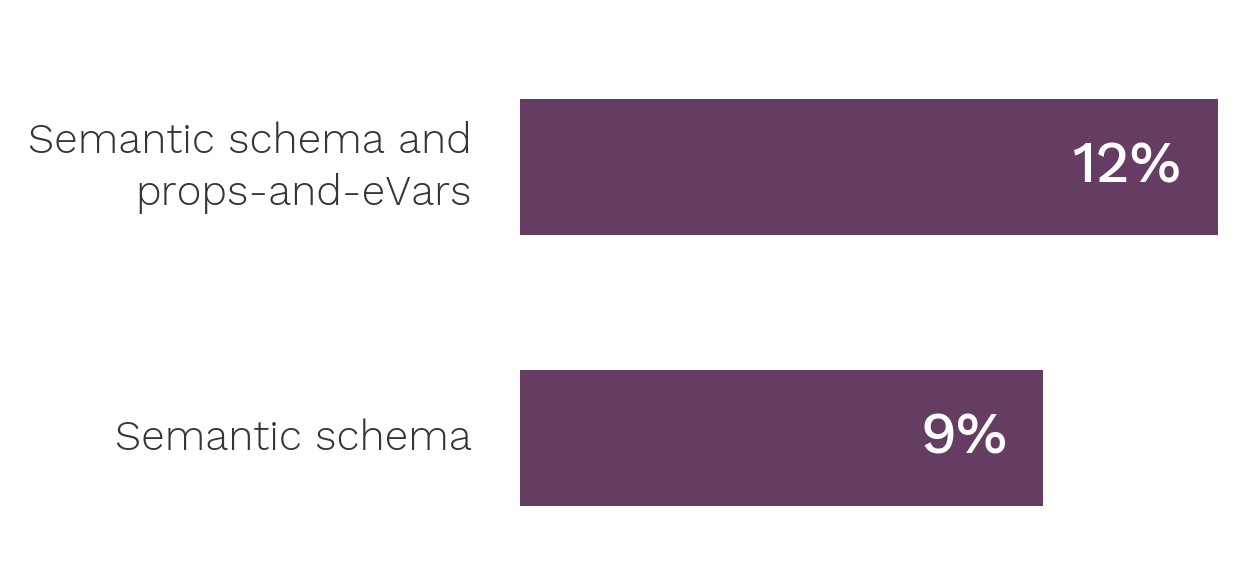
At 21%, the adoption of semantic schema remains low. Even within this group, those that have fully shed props-and-eVars is even smaller. Only 9% of all implementations are collecting only semantic schema. This is effectively the group that has fully transformed over to Customer Journey Analytics and successfully sunset Adobe Analytics. |
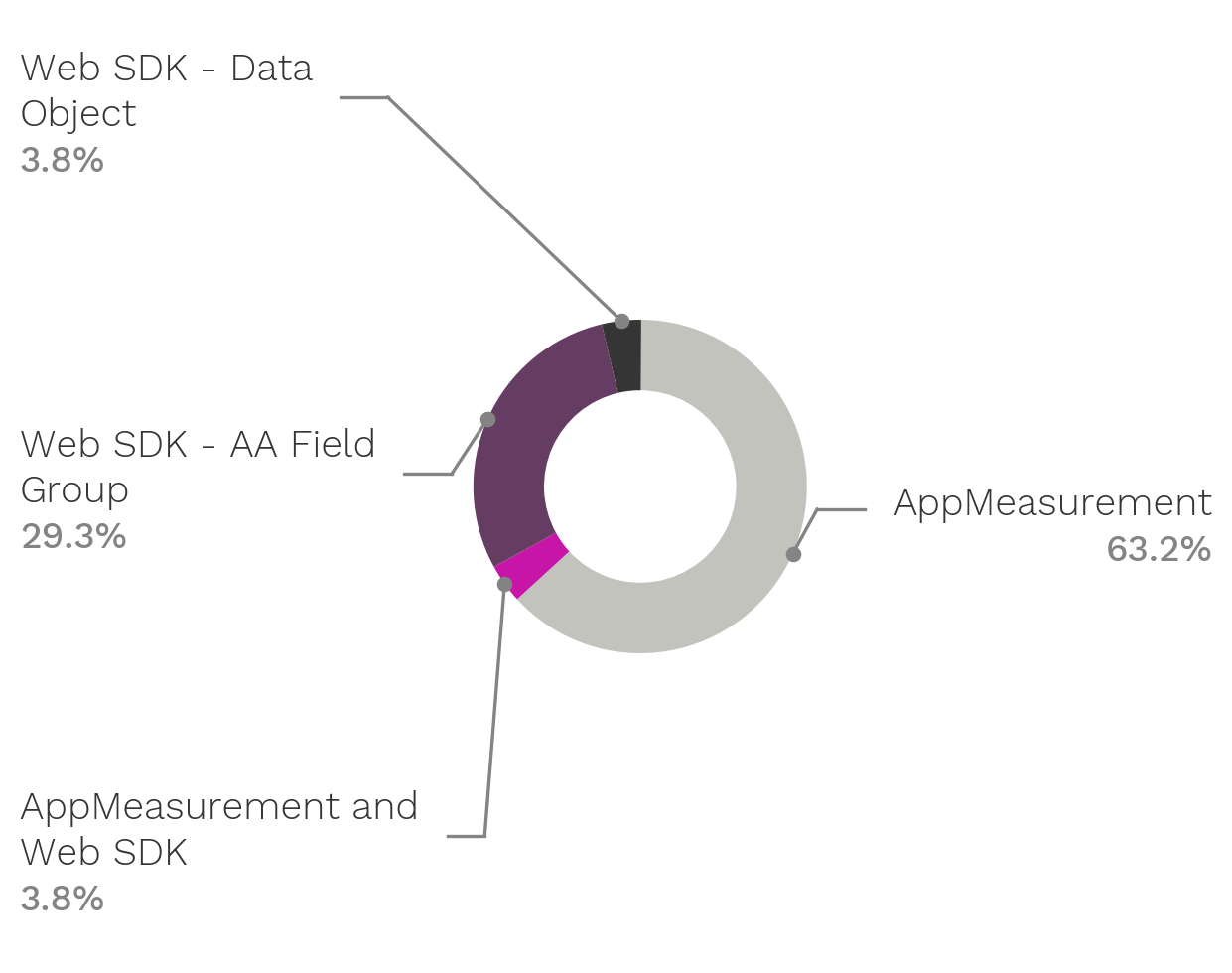
The dominance of the props-and-eVars format isn’t entirely a surprise. Adobe Analytics has been around for 20+ years, and many of these implementations span at least half of that. Going through an entire implementation and mapping it to a new data format, however modern or readable, is a significant lift for most organizations. In contrast, Adobe Target implementations in this same sample migrated to Web SDK at a noticeably higher rate, which makes sense when there's no schema to redesign along the way.
What might be missing?
As hinted at earlier, there are some blind spots. Server-side integrations with Adobe Experience Platform quietly sidestep a client-side scraper. I know of several brands in this list running Customer Journey Analytics server-side that don't show up here. Authenticated experiences behind a login would similarly be missed. Even so, I have a pretty strong understanding of the companies within this list, and it’s an exclusive group. Adding them back in likely keeps the share of post-Adobe Analytics companies not much more than 10%.
Where the leaders in Customer Journey Analytics adoption are heading next
These results point to something structural: Adobe Analytics requires a props-and-eVars format, while Customer Journey Analytics rewards a semantic schema, which means real modernization travels with the decision to replace Adobe Analytics rather than ahead of it.
What this analysis shows is that Adobe Analytics customers are opting for a perceived middle ground. Companies update the data distribution to Web SDK, but stop short of updating the data shape. It can look like modernization on a roadmap, but it fails to deliver the incremental use cases that drive value.
A small but meaningful segment is taking this inflection point to go a different direction. They are choosing to control their own destiny and bring data collection in-house. More than one Customer Journey Analytics customer has entirely bypassed Adobe’s SDKs, which is why my scraper never saw them. Modernization doesn’t have to take one preordained path. Regardless, the top-performing teams have stopped describing customer behavior in variables that only mean something in a report suite.
At possibly this industry’s biggest crossroads, the distance between the leaders making the full modernization leap and those lagging behind continues to widen. Moving past props and eVars is what makes everything downstream possible, including person-based journey analytics, real-time personalization, and the AI-driven use cases that machine-readable data affords.
At Adswerve, it is our passion to help organizations move from a laggard to a leader. In fact, within the elite few companies that have fully adopted Customer Journey Analytics in this analysis, a full one-third are Adswerve clients, so we know how to put props-and-eVars in the past. If you’re staring at a list of eVars, trying to find an empty one to repurpose, we’d love to talk about what modernization can look like for you.