Key takeaways
- Nearly 60% of Google searches end without a click to an organic result. Understanding how AI search visibility impacts customer consideration is critical for success in a zero-click world.
- LLMs use multiple mechanisms to retrieve content: direct data partnerships, news partnerships, RAG, and core model training.
- Schema markup, topic-specific content that signals real expertise, and offsite reputation management are among the highest-leverage tactics for improving AI search visibility today.
- Standard analytics tools only capture what clicks through to your site. Measuring actual AI search visibility requires a different approach.
Search has always evolved, but what's happening right now feels different. Nearly 60% of US searches now end without a click on any organic result. Users are getting answers directly on the results page, or skipping traditional search entirely and going straight to a large language model (LLM) like Gemini, ChatGPT, and Perplexity. That changes what teams need to optimize for and how we approach measurement.
For GEO, AEO, AI Overview optimization — whatever you're calling it — the tactics are evolving, but the foundation you used to optimize for SEO stays the same.
Where do LLM responses actually come from?
To understand where the new opportunities are, it helps to understand how LLMs actually retrieve and surface information. There are four primary mechanisms at play:
Direct data partnerships
LLMs have established direct partnerships to feed specific content into their models in real time. The most prominent example is Reddit, which has partnered with both Google and OpenAI. That means that every comment and subreddit flows directly into those models, gets cited frequently, and updates quickly. Other platform partners include WordPress, Tumblr, X (which has its own AI via xAI), and Stack Overflow.
This shift underscores the critical importance of off-site brand reputation. Because these models ingest community-driven data directly, your brand’s presence in "unowned" spaces now carries as much weight as your own website in shaping how an LLM perceives and recommends you.
Partnerships with reputable news sites
LLM companies have also partnered with specific news outlets to improve accuracy and reduce hallucinations. Content from these outlets carries extra weight in model outputs, which cuts both ways: strategic digital PR placements on these sites have more value than ever, and negative coverage there surfaces in LLM responses faster than you might expect.
Retrieval augmented generation (RAG)
This is how LLMs search the web in real time, essentially running Google and Bing queries to gather supporting information before generating a response. For a single prompt, an LLM might execute anywhere between two and 10 searches. And critically, those searches frequently don't pull from the top-ranked pages.
That's because LLMs aren't optimizing for domain authority or ranking signals the way traditional search does. While long-form content still plays a vital role in building overall authority, LLMs often look for the clearest, most directly useful answer to a specific query.
In fact, BrightEdge research found that nearly half of all AI Overview citations come from pages outside the top organic rankings. That means you no longer have to plan content based on its ability to rank on page one of Google. Instead, you can focus on the specific value it provides the reader by answering unique, high-intent questions that might otherwise be overlooked.
Core model training
Every LLM starts from a base model trained on a large corpus of data. That foundation shapes how the AI understands topics, entities, and brand context, even as real-time web searches and news partnerships layer on top of it. This one is less of an action item and more of a reason why consistent, long-term brand presence across the web compounds over time.
How do you improve your brand's visibility in AI search results?
AI search visibility is shaped by four factors: how well your content is structured, how authoritative and specific it is, how your brand is represented off-site, and how well your pages perform technically.
Technical SEO fundamentals
Page speed, Core Web Vitals, internal linking, and clean site architecture still matter. LLMs use RAG to fetch content, and pages that are slow to load or poorly structured are harder to index and surface, regardless of content quality. A Core Web Vitals audit focused on specific, actionable element-level improvements is a practical first step.
Schema markup
Schema.org remains the gold standard for helping crawlers, bots, and LLMs understand your content. Start with a site audit to identify what's already implemented and where gaps exist, then map your key content types to available schema from the schema.org library and build out recommendations with actual JSON-LD scripts and validation testing. Schema can also be deployed through Google Tag Manager using custom HTML tags and custom variables, which is a useful path when development timelines are slow. Just make sure tags fire early in the page load sequence to avoid validation issues.
Topic-specific, authoritative content
Because RAG searches are highly specific and often reach well beyond top-ranked pages, there's real value in developing content that answers the narrow, high-intent questions your audience is actually asking LLMs. Use organic ranking data and Search Console insights to identify where your brand has genuine subject-matter authority, then go deeper on those topics rather than broader.
Offsite reputation and digital PR
How your brand is represented across Reddit, news sites, review platforms, and other third-party sources directly influences how LLMs describe and recommend you. Identify the sources LLMs are actually citing for your category. Those will form your priorities for digital PR and community engagement.
How do you track your brand's presence in LLM responses?
Traditional analytics tools only capture what clicks through to your site. If an LLM cites your brand, summarizes your content, or influences a purchase decision but the user never clicks, that interaction is invisible to Google Analytics. And that gap is growing: ChatGPT alone now has 900 million weekly active users, the majority of whom are conducting research that drives purchasing decisions entirely outside any clickstream-tracked environment.
The "alligator mouth" pattern in Search Console is an early signal worth monitoring: impressions holding steady or rising while organic clicks decline sharply. That divergence often means your content is surfacing but users are getting their answer without clicking through — from an AI Overview, a featured snippet, or a direct LLM response.
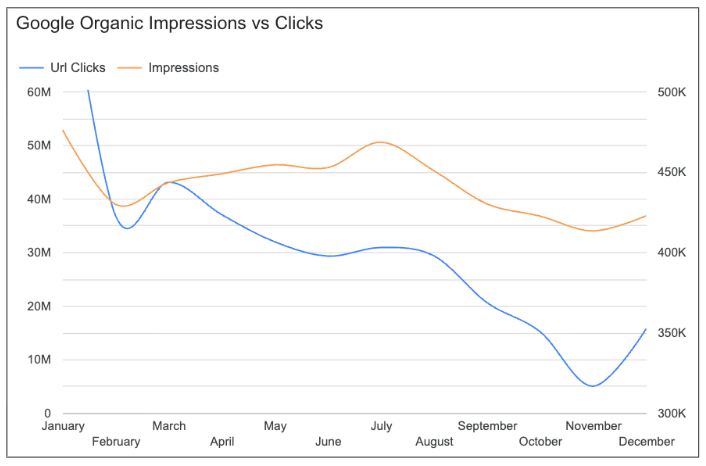
Note: When analyzing these trends, keep in mind that Google recently confirmed a bug in Search Console that may have inflated impression counts for certain periods. Always cross-reference your impression data with long-term trends to ensure your "alligator mouth" is a result of shifting user behavior rather than a reporting anomaly.
But impressions are still just a proxy, and they’re only available for search, not LLMs. Since LLMs don’t currently offer any reporting, building a more complete picture requires prompt-based tracking. That requires defining a representative set of queries your audience is likely asking LLMs, then systematically monitoring how your brand appears in the responses.
-
Which sources are being cited?
-
Where are competitors showing up that you aren't?
-
Which of your own pages are getting pulled and which aren't, despite strong organic rankings?
That methodology surfaces the gaps that Search Console can't show you, and it gives organic, PR, and content teams a concrete brief for where to focus.
What this means for your strategy
For most teams already doing solid SEO work, GEO and AEO are an extension of what it means to create genuinely helpful, well-structured, authoritative content. The goal is still the same: show up clearly and credibly when your audience is looking for answers. But there are meaningful improvements you can make to your content to ensure that you’re boosting your visibility with LLMs.
If you're curious about where your brand stands in AI search today or want to explore what an AI visibility audit might look like for your organization, reach out to our team.